

If the AC or heating system acts up, the cab gets sweltering or freezing fast. It can even mess with your safety—especially when you need to defrost the windows. To fix this problem, first you’ve got to find the blower motor. This guide shows you where the blower motor is located and its parts on your off-road machine.
Where Is the Blower Motor Often Located?
Blower motor location in off-road machines changes a lot depending on the equipment’s type and model. The trick is to figure out where the main HVAC unit is installed.
For machines like excavators, wheel loaders, and dozers, the whole operator cab is a self-contained module. Thanks to this design, the blower motor is usually in the main HVAC housing, right behind or under the operator’s seat. You’ll normally see a big plastic unit here that holds the heater core, evaporator, and the blower motor itself. The motor is easy to spot—it’s often a cylindrical or snail-shaped part attached to this housing.
As for farm gear like tractors, the location can be all over the place. Common spots include:
- Roof lining: A lot of modern tractor cabs put the HVAC system in the roof to free up space and boost visibility inside the cab.
- Under the dash or console: Just like cars, some tractors tuck the blower motor behind panels below the main instrument cluster.
- Beneath the seat: Same as construction equipment, this is still a common, easy-to-reach spot.
Doesn’t matter what machine you’re working on—the same rule applies: the blower motor is the part that pushes air through your vents. So it’s always part of the main air duct system.
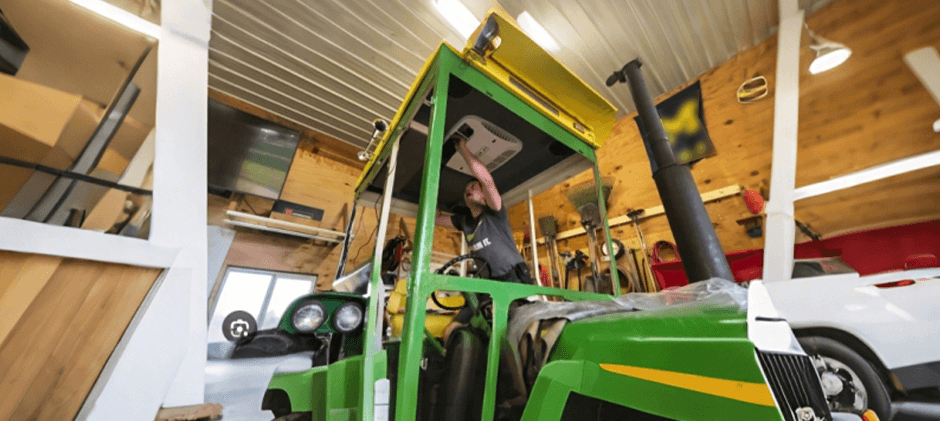
Tips for Accessing the Blower Motor
Removing the blower motor can be difficult or easy, and following certain steps will make the job easier.
- Before any electrical operation can be performed, the negative terminal of the battery must be disconnected. This is about safety, avoiding short circuits and also protecting some electronic components of the machine.
- Then consult the machine’s service manual or operating manual. The most accurate illustration and location information for your device will generally be in the manual. If the manual is lost, it can also be found. Look behind the seats, under the dashboard, or on the roof for removable panels. It is usually secured with screws, bolts or plastic clips.
The HVAC housing is visible after removing the panel. The blower motor is well recognized by its shape and the wires connected to it. The disassembly steps are as follows:
- Unplug the power connector.
- Locate the screws or bolts that secure the motor. Usually, there are three or four.
- Remove the screws and remove the motor and its attached “mouse cage” fan from the housing.
Tip: The fan is noisy or vibrating; most likely, debris is stuck in the squirrel cage fan. In this case, just clean the fan cage.
Take the motor off first to check if it’s the cause of the problem. Then you need to know how to test the blower motor. If the motor runs fine during the test but won’t work on the machine, the issue might be with another small part — the blower motor resistor.
Where is the Blower Motor Resistor Often Located?
The fans are able to operate at different speeds because of the blower motor resistors. When choosing a lower fan speed, the resistor increases the resistance of the circuit, thereby reducing the motor speed. Generating resistance also generates large amounts of heat. Therefore, resistors are almost always installed where wind energy blows to dissipate heat. That’s why you’ll find the blower motor resistor right next to the blower motor — either on the HVAC housing or the air duct.
Here’s how to spot it: it’s a small part with a plug (usually 4 or 5 wires). It’s attached to a metal plate and screwed onto the air duct. The resistor element itself is typically a coil or a metal block with cooling fins, sticking into the air duct to get cooled by the airflow. Since it’s close to the motor, checking it is easy.
Diagnosing symptoms of a faulty blower motor resistor is simple, too — the most common sign is the fan only working on the highest speed.
Tips for Accessing the Blower Motor Resistor
Since the resistor is located next to the motor, the steps to access are very similar to those for the motor. In many cases, after removing the access panel, the resistor can be seen.
Find a multi-wire plug on the outside of the air duct. After unplugging the connector and unscrewing the screws, the resistor assembly can be pulled directly out of the air duct. It can be done with just basic hand tools. Therefore, this is an easy part to check and replace during fault diagnosis.
Conclusion
To find the blower motor, you should locate the HVAC housing first. It is usually located behind the seat, in the cab roof, or in the dashboard console. The blower motor resistor is mounted on a nearby air duct. By following a safe and systematic way, you can diagnose and replace these parts efficiently. Browse the list of blower motors for your equipment at FridayParts. All our products ensure you get the best value for your money. If you have any questions, please feel free to contact our professional team.
