

You’ll often see the term MFWD when checking tractor specs or shopping for farm equipment. Short for Mechanical Front Wheel Drive, it’s a common drive system on modern tractors. It boosts traction, handling and overall work efficiency — and works especially well on soft, muddy or bumpy ground.
What Is Mechanical Front Wheel Drive?
MFWD stands for Mechanical Front Wheel Drive. The “Mechanical” part of the name is the most important distinction. It tells you that there is a physical, solid link between the transmission and the front axle.
In an MFWD system, power is transferred through a series of rigid components. Unlike older two-wheel-drive tractors that relied entirely on the rear tires for “push,” MFWD allows the front tires to “pull.” This is why many of us in the shop refer to it as Front Wheel Assist (FWA). On these tractors, you will notice the front wheels are typically smaller than the rears; they are designed to assist the primary drive tires, not replace them. The system relies on three core mechanical components to get the job done:
- Drive Shaft: A steel shaft that carries rotational power from the rear transmission to the front of the tractor.
- Differential: A gear set in the front axle that allows the front wheels to rotate at different speeds when you are making a turn.
- Front Axle: The heavy-duty housing that contains the final drive gears and supports the weight of the front end.
MFWD vs. 4WD
In farming, when people say true 4WD, they’re talking about big articulated tractors. These rigs bend in the middle to turn, and all four tires are the same size. Since they pivot at the center, the front and rear wheels trace the same path when cornering.
MFWD is different — it’s for regular tractors. They steer like a car with the front wheels, and the front tires are nearly always smaller than the rear ones.
| Feature | Articulated 4WD | MFWD (Front Wheel Assist) |
|---|---|---|
| Steering Method | Articulated (Pivots in middle) | Front Axle Steering |
| Tire Size | All four tires are equal size | Front tires are smaller than rear |
| Engagement Type | Often full-time 4WD | Selectable (Toggle on/off) |
| Primary Use Case | Heavy tillage and large-scale Ag | General farming, loader work, utility |
“While both systems provide power to all four wheels, the path the wheels take during a turn is what defines how they handle under load.”
Mechanical (MFWD) vs. Hydrostatic (HFWD)
Not all front-wheel drive setups use a mechanical driveshaft. Small garden tractors and older specialty models often run HFWD (Hydrostatic Front Wheel Drive). Instead of gears and a driveshaft, they use hydraulic pumps, hoses and wheel motors to power the front tires.
HFWD rides smoother when making tight turns, since the front wheels spin separately from the rears. But for tough, heavy work, MFWD is far more reliable. Mechanical systems handle high torque and heavy pulling easily. Hydraulic setups, though, heat up a lot under big loads and can even stall when pressure gets too high.
What Are the Advantages of MFWD?
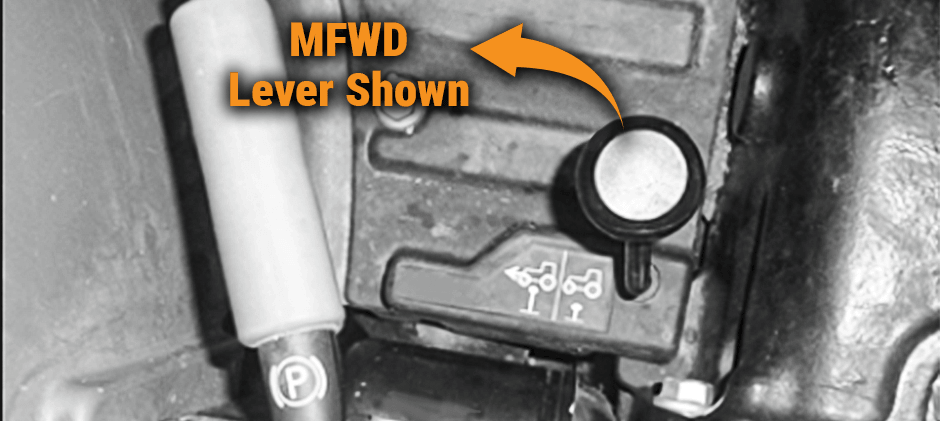
Flipping on the MFWD lever or switch isn’t just for getting through mud. It boosts your tractor’s performance in three key ways:
- Traction: With the front wheels pulling too, you can tackle wet ground and thick clay. A regular 2WD tractor would just spin its rear tires here.
- Braking: Most new tractors get full four-wheel braking when MFWD is on. The driveshaft connects the front and rear axles, so when you hit the brakes, all four wheels slow the machine down. This is a big safety plus when hauling heavy loads or driving on slippery ground.
- Slope control: MFWD keeps steering steady on hills. Since the front wheels are pulling, they’re far less likely to slide or drift on inclines.
Take extra care on slopes. MFWD improves grip and braking, but don’t let it make you overconfident on steep ground. Better traction doesn’t change the tractor’s center of gravity — steep hills still carry a real risk of tipping over.
Tips for Operating MFWD
Follow these pro tips to keep your MFWD running well and avoid costly repairs:
- Turn it off on paved roads: Don’t use MFWD on hard pavement. Front wheels are built to spin a little faster than the rears, so running it here will jam up the drivetrain and wear tires out fast.
- Know how the front wheel lead works: Front tires are set to turn slightly quicker to keep pulling steadily. This keeps steering tight, takes stress off parts and cuts tire scrub when turning sharp. But if front tires wear down much more than the rears, this balance shifts and puts extra strain on the mechanics.
- Use Auto mode: Most new tractors have an Auto setting. It automatically shuts off MFWD at road speed to prevent wear, and kicks it back on when you brake for better stopping power.
- Keep tires properly inflated: Stick to the manufacturer’s recommended front tire pressure for hard surfaces and road travel. This keeps tire size and performance as designed.
- Ease the load to shift it out: If the MFWD lever gets stuck, lighten the load or back up a little. This eases pressure on the gears so you can disengage it smoothly.
Conclusion
MFWD is an optional mechanical system that adds front-wheel assist and boosts safety with four-wheel braking. It has lots of moving parts like universal joints, seals and specialized gears, which wear out over time under constant stress. When repairs are needed, FridayParts supplies high-quality replacement drivetrain parts compatible with most major brands.
