

Steep or hilly slopes look great, but they’re tough on lawn mowers. This kind of terrain makes lawn care tricky, and it can be really dangerous without the right equipment and safety steps. That’s why you need the best mower for hills — pick one that fits your actual slope and conditions.
Challenges of Mowing On Hills
Before we talk about solutions, let’s first get clear on the real issues with hilly yards.
Losing Traction
On a hill, especially with wet grass or hard, dry dirt, mower tires can easily slip. For ride-on mowers, that can mean sliding out of control. The direction you mow makes a huge difference. Riding mowers are usually safer going straight up and down. Walk-behind mowers work better going across the slope to keep you from slipping.
Tipping Risk
A mower’s center of gravity is important on hills. If it’s top-heavy, it’s less stable and way more likely to tip over. Regular lawn tractors often feel wobbly on steep slopes because their weight isn’t balanced for uneven ground.
Getting Enough Grip
Regular lawn tires are made for flat yards and don’t have deep enough tread for hills. Tires with bigger, deeper tread — like lug or chevron patterns — hold way better. Tire pressure matters too. If tires are too low, they flatten out and lose grip exactly when you need it.
Tough Ground Conditions
Hills make bad ground even worse. Wet, muddy slopes turn into a slippery mess that almost no mower can handle. Hard, dry dirt can be just as slippery, with nothing for the tires to grab onto.
Getting an Even Cut
Safety aside, getting a nice, even cut is hard on slopes. When the mower tilts, it cuts too short on the high side and too long on the low side. You need a mower deck that can adjust to the terrain to keep the cut consistent.
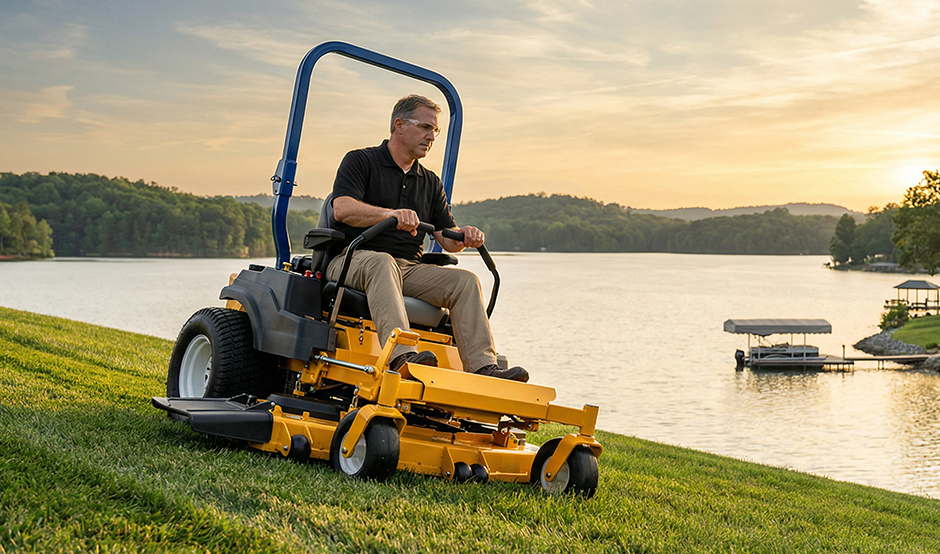
Best Lawn Mowers for Hills: Our Top Picks
For very steep and demanding slopes where regular mowers aren’t safe, you need features like all-wheel drive, a low center of gravity, and strong engines.
Remote-Control Track Mowers
Remote-control track mowers are one of the best options for extreme slopes because they let you operate the machine from a safe distance.
- Bestin Mower CFTH-140 is a heavy-duty remote-control track mower with a 55-inch deck, built for slopes up to 45°.
- RC Mowers R-Series can handle up to 50° slopes and also cut through brush up to 1.5 inches thick.
Specialized 4WD Mowers
Specialized 4WD mowers are also used for tough terrain.
- Spider 2SGS EFI can handle slopes up to 60° and includes a winch for extra stability.
- Ventrac 4520 is well known for slope performance and can be made even more stable with dual wheels.
- Steiner 450 uses an articulating frame and 4WD for better balance on uneven ground.
Zero-Turn Mowers
Zero-turn mowers usually don’t perform well on hills, but some newer models are designed for better slope control.
- Cub Cadet Ultima ZTXS Series uses Synchro-Steer™ technology for better stability on slopes up to 20°.
- Cub Cadet Pro Z 972 SD is built for steeper commercial use up to 25°.
- Toro TimeCutter MyRide Series offers better comfort and control on rough hills, while the John Deere Z500 Series (like Z515E and Z530M) performs well thanks to its wide stance and strong engine.
Stand-On & Walk-Behind Mowers
People with tricky, steep yards love these because they’re easy to move and safe. You can use your body weight to help balance the mower for better grip.
- Toro GrandStand Series: A top commercial stand-on mower that’s fast like a zero-turn and agile like a walk-behind. You can shift your weight easily to stay steady on slopes.
- Scag V-Ride II: Super low center of gravity and built tough. It comes in different deck sizes and is a reliable choice for pros on hills.
- Ferris SRS Z3X: Has a special suspension and pivoting front wheels, so tires stay in contact with the ground better on uneven slopes.
- Toro 21″ Super Recycler: A walk-behind mower with self-propelled “Personal Pace” and a strong engine. Perfect for steep spots big ride-ons can’t reach.
Front-Mount Mowers
These have the cutting deck in front instead of under you. You can see better, and the longer wheelbase and low center of gravity make them really stable on hills.
- Toro Groundsmaster Series: Loved by professionals for great stability on slopes and strong cutting power.
- Grasshopper (Front-Mount Models): Durable and reliable on tough, hilly terrain.
- Kubota F-Series: Proven to work really well on rough, sloped yards — even older models like the F2000 make the job quick and easy.
| Mower Type | Best For | Key Strengths | Potential Weaknesses |
|---|---|---|---|
| Steering-Wheel ZTR | Moderate slopes, properties with many obstacles | Speed, maneuverability, better control than lap-bar ZTRs | Can still lose traction; higher cost |
| Front-Mount Mower | Steep hills, large properties, professional use | Exceptional stability, great visibility, excellent cut quality | High cost, less maneuverable in tight spaces |
| AWD Slope Mower | Extreme slopes, thick brush, rugged terrain | Unmatched climbing ability, highest level of safety, robust build | Very specialized, highest price point |
Conclusion
Mowing on hills puts huge stress on every part of your mower. The engine works way harder, the transmission is under constant load, and the frame and cutting deck also get twisted and strained. When you need to replace parts, FridayParts has high-quality, affordable replacement parts for all major mower brands. We’ll make sure your machine is always ready to handle any hillside.
FAQs
How to mow a steep hillside safely?
Safety’s always the most important thing when mowing hills. Here are some easy rules to follow:
- If you’re using a ride-on mower, always go straight up and down the hill — don’t go sideways. Going side to side on a steep hill can easily make the mower tip over. The only time it’s okay is if you have a special slope mower or front-mount mower that’s made for that.
- Always check your mower’s manual, and never mow on a hill steeper than the manufacturer says. Most regular ride-on mowers are only safe on hills up to about 15 degrees.
- If your mower has ROPS (rollover protection), keep it up and always wear your seatbelt. They’re made to work together to keep you safe.
- Go slow, and be extra careful when the grass is wet or slippery. If it’s too bad out, just wait until the ground dries off.
- Also, keep your blades sharp. Sharp blades cut easier, so the engine doesn’t have to work as hard — especially when you’re going up hills.
What type of mower is best for steep hills?
- For really steep hills, AWD (all-wheel drive) slope mowers like Grillo or Razorback are the best choice.
- If the hill isn’t super steep but still tricky, a front-mount mower or a heavy-duty garden tractor with a locking differential is safer and works better.
- For moderate slopes, zero-turn mowers with a steering wheel are okay to use, but regular zero-turns with lap bars aren’t great for hills.
Which mower deck size is best for slopes?
On hills, control matters more than cutting width.
- 48″ – 54″ decks: Best balance of speed and handling. Smaller decks are lighter and easier to control on bumpy, sloped ground.
- 60″ decks: Work fine on big, smooth slopes but can feel hard to handle on uneven, twisty hills.
- 72″ decks: Mostly for commercial use only, like the Cub Cadet Pro Z 972SD, which uses dual rear wheels to handle the extra weight and width safely on hills.
