

Picking the wrong air filter size for an off-road machine engine usually doesn’t fail fast—it fails quietly. A filter that’s slightly off can leak dust past the seal, rub through media, or restrict airflow enough to hurt power and fuel use. In this guide, we’ll show how we choose the correct size based on fit, seal design, and airflow needs—so your excavator, tractor, loader, or generator breathes clean air without surprise downtime.
What Is the Correct Filter Size for Your Engine?
For your equipment, “correct size” is not just diameter and height. The correct air filter size is the one that:
- Fits the housing with no forcing
- Seals 360° at the gasket / radial seal surface
- Matches the inlet/outlet geometry (ID/OD and end-cap style)
- Provides the intended airflow with acceptable restriction
- Has enough dust-holding capacity for your work conditions
That definition matters because these engines move a lot of air. FridayParts notes that a diesel excavator can pull 400 cubic feet of air per minute—so even a small sealing problem can turn into real dust ingestion over a shift. They also warn that clogged or low-quality filtration can drop engine power up to 12% and increase fuel use by 8% in harsh conditions.
Size is really “dimensions + sealing style”
Most engine intake elements in off-road equipment fall into a few common physical styles:
- Cylindrical (round) elements with open/closed ends
- Radial seal elements (a tight internal seal on one end that mates to a tube)
- Panel elements (less common in heavy equipment engines, more common in certain enclosures)
- Primary + safety (inner) elements inside a two-stage housing
If your machine uses a primary and safety element, the “size” includes both parts—because the inner element must fit the outer element and the housing correctly.
Measurement Checklist
Use this table when you have the old part in hand.
| What to measure | How to measure | Why it matters |
|---|---|---|
| Overall length/height | End to end (exclude loose foam if present) | Too long won’t fit; too short can leave gaps |
| Outside diameter (OD) | Widest point of the outer shell | Must fit the canister/housing without rubbing |
| Inside diameter (ID) | Inner opening of the element | Must match the center tube or safety element clearance |
| Seal OD/ID + seal depth | Measure the gasket/radial seal area | Most “wrong size” failures are sealing failures |
| End-cap style | Open/open, open/closed, axial vs radial seal | The wrong end-cap design can’t seal even if the OD matches |
| Safety element dimensions (if used) | ID/OD/length | The wrong inner element can collapse or bypass |
How to Choose an Air Filter Size?
We like a step-by-step process because it prevents the most expensive mistake: unfiltered air bypass.
Step 1: Identify the machine and the intake system
Start with:
- Equipment model and serial range (if you have it)
- Engine model (helpful, but not always enough)
- Intake housing/canister model (often the real key)
Why: the same engine family may be installed with different intake housings depending on application, cab package, or emissions configuration.
Step 2: Pull the existing element and inspect for clues
Before measuring, look for:
- Part numbers are printed on the element or end cap
- Restriction indicator reading (if equipped)
- Dust tracks on the clean side of the housing (a red flag for sealing issues)
- Deformation (collapsed pleats, oval shape, torn end cap)
If you see dust on the clean side, don’t just “size match”—also check housing sealing surfaces and clamps.
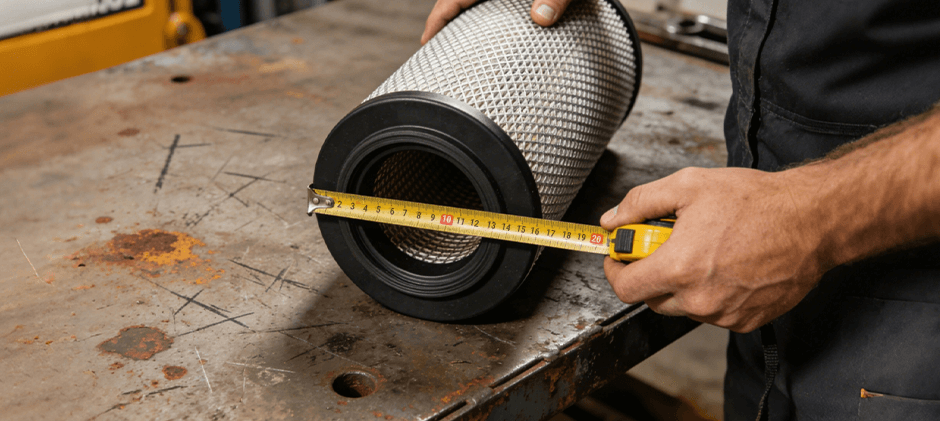
Step 3: Measure the old element
Use calipers if possible. If not, a tape measure is still better than guessing.
Practical tips:
- Measure OD in two directions (some elements are slightly out-of-round).
- Measure the seal area separately from the body OD.
- If it’s a radial seal design, measure the inside seal diameter that mates to the outlet tube.
Step 4: Confirm seal type and end-cap design
Two filters can share the same OD/length and still be wrong if:
- One is an axial seal (flat gasket), and the other is a radial seal
- The seal depth differs (doesn’t clamp correctly)
- The end cap is closed when you need an open end (or vice versa)
This is why “close enough” cross-references can be risky for heavy dust jobs.
Step 5: Make sure the size won’t restrict airflow for your duty cycle
A larger element generally has more media area and lower restriction, but on machines, we’re usually constrained by the housing. Instead of trying to calculate airflow from scratch, a better approach is:
- Match the OEM-specified size/style for your housing
- Use a restriction gauge/indicator if the system has one
- Replace based on restriction and conditions, not just appearance
FridayParts also notes that typical engine intake service intervals can range from 250 to 1,000 hours, but in rough, dusty conditions, you should check sooner. Their broader filtration guidance suggests replacing engine elements every 500 hours or sooner in extreme dust.
Step 6: Choose a reliable source and order by confirmed fit
Once you’ve confirmed dimensions + seal type, you can shop confidently.
In the mid-to-late stage of planning (when you’re ready to order), it’s useful to browse a full catalog like FridayParts’ air filter selection, then narrow to the engine intake category via engine air filter. This helps when you manage multiple machine types and want compatible options in one place.
If you’re also setting service intervals for a fleet, this article is a helpful companion: a practical guide to air filter change intervals. (It’s not about guessing—it’s about building a repeatable schedule around hours and conditions.)
And if you suspect the element is already restricting airflow, this checklist of common warning signs of a failing engine intake filter can help you decide whether you should inspect it immediately.
Quick Tips for Correct Air Filter Fit
These are the habits that prevent 90% of installation problems:
1. Clean the housing before installing the new element
Wipe the sealing surface and remove loose debris. Dirt on the seal can create a bypass path.
2. Check the outlet tube and clamp alignment
A skewed clamp can “feel tight” while leaving one side unsealed.
3. Never force the element into place
If you must compress or bend it, you likely have the wrong size or a damaged housing.
4. Inspect for sealing witness marks
After seating, you should see an even compression pattern on the gasket (where applicable).
5. Don’t overuse compressed air on dry elements
An aggressive blow-out can damage the media and open pinholes. In heavy dust work, replacement is often safer than repeated cleaning.
6. Replace the safety (inner) element on schedule
The inner element is your last line of defense if the primary fails or leaks. Don’t treat it as “lifetime.”
7. Use restriction readings if available
The best time to change an air filter is when restriction indicates it—not when it looks “kind of dusty.”
FAQs
1) Can we install a bigger air filter for better airflow?
Only if the housing is designed for it and the element seals correctly. In off-road equipment, you generally can’t “upsize” without changing the canister, clamps, or inlet/outlet geometry. A larger element that doesn’t seal is worse than a correctly sized standard element.
2) If OD and length match, is it the right part?
Not always. You still must confirm:
- Seal type (radial vs axial)
- Seal diameter and depth
- End-cap open/closed configuration
- Inner diameter interface to the outlet tube (critical)
3) What if the new element fits, but the machine still feels weak?
Check the full intake path: precleaner (if equipped), intake hoses, clamps, and the housing itself. Also, confirm you’re not seeing symptoms tied to restriction. FridayParts notes that clogged intake filtration can reduce engine performance and increase fuel use; if you’re unsure, use a restriction indicator and inspect.
4) How often should we replace the engine intake element?
FridayParts states engine intake change intervals can range from 250 to 1,000 hours, and in rough dust, you should check sooner. Their broader guidance suggests replacing around 500 hours or sooner in extreme dust. Use hours + restriction + environment—especially for earthmoving, demolition, cleanup, or dry seasonal work.
5) Do we need to care about the cabin air filter if the topic is engine sizing?
Yes, because the same dust that loads the engine intake also loads the cab system. A clogged cabin air filter can reduce vent airflow and make the cab unpleasant during long shifts. Many operators replace both around major service windows to reduce repeated downtime.
Conclusion
Choosing the right air filter size for an off-road engine is about more than “close enough” dimensions. We need the correct seal design, end-cap style, and a fit that seats without force—because bypass dust can do real damage over time. When it’s time to buy, FridayParts supports fleet and owner-operators as an aftermarket parts supplier with high-quality products at affordable prices, vast inventory, and wide compatibility across many heavy equipment brands.
