

You’ve probably noticed that the Ford 8N vs 9N look almost the same at first glance. These two models are classic for small farms, but they drive and work quite differently.
In our years of consulting for restorers and hobby farmers, I have seen many buyers assuming these units are interchangeable. Here we’ll talk about the key differences between the Ford 8N and 9N. focusing on the evolution of the transmission, hydraulics, and mechanical refinements that define these classics.
A Brief History of the Ford N-Series
If you’re new to Ford N-Series tractors, the model names can be confusing, since the model numbers don’t go in normal order. To pick the right tractor, let’s start with its production years and the legal dispute that pushed Ford to make changes.
- Ford 9N (1939–early 1942): This was the first model from the Ford-Ferguson partnership. It came with the game-changing three-point hitch.
- Ford 2N (1942–1947): It’s basically a wartime version of the 9N. Shortages of parts meant most 2Ns used steel wheels and magnetos, instead of batteries and starters. Even with the 2N name, these tractors still used the 9N serial number prefix.
- Ford 8N (1947–1952): The most popular individual tractor model in North American history.
The switch from the 9N/2N to the 8N wasn’t just a regular upgrade. It all started when Henry Ford and Harry Ferguson ended their informal partnership. After the split, Ferguson sued Ford over patent issues. To respond, Ford reworked multiple systems and made major engineering changes to set the new 8N apart from the older models. The updated 8N launched in 1947. It dropped several original Ferguson designs and added new features, making it a much more reliable work tractor.
How to Tell a Ford 8N from a 9N?
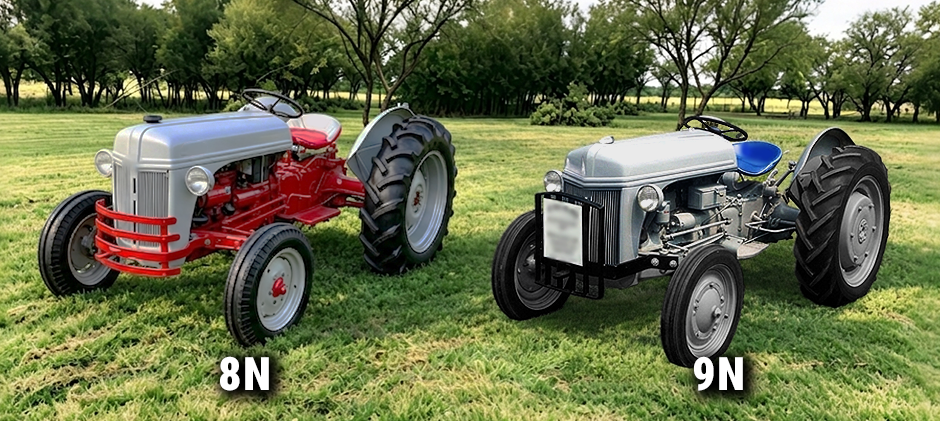
Use these easy visual tips to tell a Ford 8N apart from a 9N, whether you’re checking tractors along fence lines or looking through auction listings. A lot of parts get replaced over 70 years of repairs, but these key features will still help you tell them apart.
- Paint: Factory 9N and 2N tractors are all dark gray. The 8N came with the famous “Red Belly” look: the hood and fenders are light gray, while the engine block, frame and drivetrain are red.
- Front Wheel Hubs & Bolt Pattern: This is one of the easiest ways to spot the difference from far away. The 9N and 2N have large 6-lug front hubs with a star-shaped layout. The 8N uses a smaller 6-lug pattern that looks more modern.
- Foot Rests: If it has factory running boards, it’s almost certainly an 8N. Older 9N and 2N models only have simple foot pegs, so your feet hang right above the transmission.
- Dashboard & Proofmeter: Some 1939 and 1940 9Ns came with aluminum hoods and dash panels — these are super desirable for collectors. Later 8Ns built from 1950 to 1952 (starting with serial number 8N-263844) have a Proofmeter on the bottom right of the dash. This single gauge works as a tachometer, speedometer and hour meter all in one.
Visual Identification Comparison Table
| Feature | Ford 9N | Ford 8N |
|---|---|---|
| Chassis Color | Dark Gray | Red |
| Front Hubs | Large 6-lug “Star” Pattern | Small, Compact 6-lug Pattern |
| Operator Platform | Foot Pegs | Full Running Boards |
| Radius Rod Braces | I-Beam (Early) / Oval Pipe | Oval Pipe / Tubular |
| Radius of Turn | Wider / Bevel Steering | Tighter / Ball-Worm Steering |
Transmission and Power: The 4-Speed Win
The most notable mechanical upgrade in the ford 8n vs 9n comparison is the transmission.
- The 9N comes with a 3-speed transmission, and it’s not ideal for modern tasks. Its first gear runs too fast for jobs like tilling soil — you need a slow, steady speed to get the work done right.
- The 8N fixed this with a 4-speed transmission, a huge improvement for anyone using the tractor. The wider gear range lets you make full use of the engine power for all kinds of tasks. The extra top gear lets you drive faster when traveling between fields, while the lower gears deliver the slow speed you need for tough field work. This flexibility makes the 8N far better for everyday jobs.
The 4-Speed Advantage
You can creep along slowly for yard and garden work, or hit higher speeds to move from one field to another.
Some 9Ns have an aftermarket Sherman auxiliary transmission. This add-on gives extra gears and more flexibility, which is a nice upgrade. Still, watch out: some Sherman overdrive units raise both travel speed and PTO speed, and that doesn’t work with all PTO tools. Always check your PTO RPM before running gear like a brush hog.
Hydraulics and the 3-Point Hitch: Position Control
You can really see the impact of the Ford-Ferguson legal split when comparing their hydraulic systems. Both tractors have a 3-point hitch, but they work differently, and this affects every job you do.
- 9N Draft Control: The original Ferguson setup uses “Draft Control”. It automatically adjusts implement depth based on soil resistance. This works great for plowing, but it’s tricky for jobs that need a fixed height. You can set the hitch to a middle position, yet it won’t stay steady — the system keeps shifting as soil resistance changes.
- 8N Position Control: To get around Ferguson’s patents, Ford built in “Position Control”. You set the hitch to an exact height, like four inches off the ground, and it stays there no matter how hard the soil is. This makes the 8N far more practical for box blades, finish mowers and snow plows.
A lot of people make a mistake thinking these two systems share parts. The hydraulic pump covers won’t swap between the 9N and 8N, thanks to the redesigned floating draft control. If you own a 9N, you’re stuck with its standard hitch function unless you install an aftermarket position control kit.
Operational Safety and Steering Layout
Safety rules back in the 1940s were nothing like today’s, and you can see that clearly in how the Ford 8N and 9N are laid out.
The Poor Brake Layout
- Most operators find the brake setup on the 9N and 2N a real Awkward. The clutch and left brake are both on the left side. You can’t press the clutch and left brake at the same time. For an emergency stop, you have to hit the clutch, shift into neutral, then apply both brakes. If you only use the right brake at speed, the tractor can spin hard and even tip over.
- The 8N moved both brake pedals to the right side. Now your left foot works the clutch and your right foot handles the brakes — this setup is far safer and more natural to use.
Steering Box Mechanics
- The 9N and 2N use a bevel-gear steering system. These gears work efficiently in both directions, so any impact to the front wheels, such as hitting rocks or hard dirt clods, sends force straight back to the steering wheel. These “clod kicks” can yank the wheel right out of your hands.
- The 8N got an upgraded ball-worm steering box. This design blocks that rough feedback from the ground, so the tractor handles much better on bumpy land.
The “Live PTO” Danger
Neither the 9N nor 8N comes with a live PTO. The PTO shaft connects straight to the transmission’s idler shaft. When running heavy gear like a brush hog, the spinning blades keep carrying the tractor forward even after you push the clutch.
Safety Warning: If you mow with any N-series tractor, an overrunning clutch (ORC) is a must-have. This accessory costs $70–$75. It stops the mower’s momentum from pushing the tractor into fences or down slopes after you release the clutch.
Engine and Electrical: Maintenance
These tractors all came factory with a 6-volt positive-ground electrical system. A lot of them have since been switched over to 12-volt setups. A 12V system does make starting easier in cold weather, but I always tell buyers this upgrade is often just a quick fix for weak engine compression. A properly running N-series engine will fire up just fine on the original 6V system.
- About Long-Term Reliability: These flathead engines are built to last, but you still need routine tune-ups and valve checks to keep them running well. Working on the valves takes more time and effort with a flathead design compared to newer overhead-valve (OHV) engines, like the ones in the Ford NAA or Massey Ferguson 135.
- Distributor Location: How easy your weekend maintenance work is will depend on what year your tractor is.
| Maintenance Task | Front-Mount Distributor (9N, 2N, Early 8N) | Side-Mount Distributor (1950–1952 8N) |
|---|---|---|
| Accessibility | Hard to reach; tucked behind the radiator. | Easy access on the side of the engine block. |
| Point Setting | Often requires removing the distributor. | Can be set while the distributor is on the tractor. |
| Moisture Resistance | Prone to “wetting” and moisture issues. | Much more reliable in damp conditions. |
What to Look for When Buying a Ford N-Series Tractor?
Looking to buy an N-series tractor? Prices differ a lot based on its condition, whether it’s all original, where you’re located, and what attachments come with it. A solid, running unit usually goes for a few thousand dollars, and fully restored ones cost way more. The 8N was super popular back in the day, but next to newer models like the Massey Ferguson 135, it’s mostly seen as a hobby or parade tractor. The Massey Ferguson 135 has double the horsepower and weight, so it handles regular farm work much better.
Before you pay for anything, check the rear wheel rims. A lot of these tractors had calcium chloride added inside the rims for extra weight. Over the years, this chemical has caused bad rust. Replacing rusted-out rims and tires can run you $1,000 or more — that’s almost half the tractor’s total value. If the rims are badly rusted, this deal isn’t as good as it looks.
Conclusion
The Ford 9N and 8N are both classic tractors that played a key role in the development of modern farming. They share the same original design, but the 8N comes with major upgrades: a 4-speed transmission, position-control hydraulics and a more user-friendly layout.
No matter which model you own, keeping a vintage tractor reliable requires quality replacement parts and regular maintenance. At FridayParts, we offer a wide range of aftermarket parts for Ford N-Series tractors, including components for the 9N, 2N, and 8N. All parts are for fit and compatibility, helping you maintain and repair your Ford tractor.
