

Every off-road equipment owner knows that understanding machine weight isn’t just about numbers — it’s about control, hauling safety, and matching the right loader to your job. Whether you’re managing heavy construction, land clearing, or farm operations, knowing your Bobcat skid steer weight determines productivity, fuel efficiency, and transport feasibility. In this 2025 guide, we’ll go beyond basic specs to explain what affects the weight of a skid steer, what the numbers actually mean, and how to choose the optimal
configuration for your needs.
Summary Table
| Category | Weight Range (lbs) | Notable Models |
|---|---|---|
| Mini Skid Steers | 2,400 – 3,500 | MT50, MT85, MT100 |
| Compact/Small | 4,000 – 5,800 | S70, S130, S150 |
| Medium | 5,800 – 7,000 | S185, S530, S590 |
| Large | 7,000 – 10,000 | S650, S770, S850 |
| Track Loaders | 6,000 – 12,600 | T450, T770, T870 |
Why Skid Steer Weigh Matters?
A skid steer loader’s weight affects nearly every aspect of its performance. The heavier the machine, the higher its lifting stability — but the greater its transportation and ground pressure challenges. Conversely, lighter models are easier to tow and maneuver yet offer lower load handling.
In off-road conditions, weight isn’t just about size; it’s the balance between traction, lifting power, and mobility.
Understanding this concept helps with:
- Trailer selection and towing compliance
- Job-site terrain adaptation
- Fuel consumption and tire wear
- Attachment compatibility
- Machine longevity and structural stress
If you ever find it confusing to connect weight to performance, check this helpful resource on how to choose your ideal Bobcat machine — it breaks down model options logically.
How Much Does a Bobcat Skid Steer Weigh?
Bobcat skid steers range from compact, versatile loaders under 3,000 pounds to large, high-power models exceeding 10,000 pounds. Here’s a categorized overview to help you locate your model’s approximate operating weight.
Mini Skid Steers (MT Series)
| Type / Model | Average Weight (lbs) | Use Case |
|---|---|---|
| MT50 / MT52 | 2,500 | Tight spaces, landscaping, light jobs |
| MT55 | 2,696 | Compact soil work |
| MT85 | 3,100 | Higher‑load mini projects |
| MT100 | 3,390 | Heavy mini construction and yard work |
Small Frame Bobcat Skid Steers
| Type / Model | Average Weight (lbs) | Use Case |
|---|---|---|
| S70 | 2,892 | Compact areas, light commercial |
| S100 | 4,091 | Slightly higher ROC for light materials |
| S130 | 5,235 | Entry‑level industrial work |
| S150 / S160 | 5,662 – 5,752 | General construction and farm |
Medium Frame Bobcat Skid Steers
| Type / Model | Average Weight (lbs) | Use Case |
|---|---|---|
| S175 / S185 | 5,808 | Lifting general pallets and soil |
| S205 | 6,242 | Heavier lifting with stability |
| S450 | 5,027 | Small commercial or rental fleet use |
| S510 / S550 | 6,213 | Balanced for construction and road work |
| S530 / S570 | 6,480 – 6,500 | Best‑selling mid‑size powerhouses |
| S590 / S595 | 6,765 – 6,793 | Top reliability across job types |
Large Frame Skid Steers
| Type / Model | Average Weight (lbs) | Use Case |
|---|---|---|
| S630 / S650 | 7,610 – 8,061 | Heavy‑duty lifting, attachment use |
| S740 / S750 | 8,700 – 8,900 | Frequent industrial lifts |
| S770 / S850 | 9,175 – 10,008 | Maximum performance, demanding loads |
Compact Track Loaders (Tracked)
| Type / Model | Average Weight (lbs) | Use Case |
|---|---|---|
| T450 / T550 | 6,148 – 7,948 | Smoother terrain coverage |
| T595 / T650 | 8,055 – 10,310 | Versatile heavy off‑road handling |
| T770 / T870 | 10,515 – 12,678 | Full‑scale commercial and mining-grade work |
Tip: The operating weight includes the machine, fluids, standard bucket, and operator (usually around 175 lbs). Attachments or counterweights add extra pounds that affect payload and transport ratings.
For more technical specs about dimensions, horsepower, and ROC, see our detailed catalog of Bobcat parts and model listings.
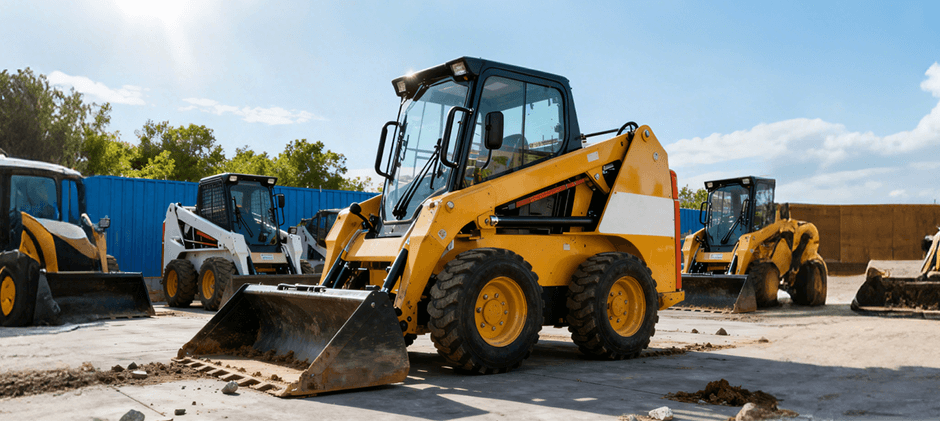
Rated Operating Capacity, Tipping Load, and Operating Weight
These three terms often confuse equipment buyers. Let’s clarify their relationship:
| Term | Meaning | Example (Bobcat S64) |
|---|---|---|
| Tipping Load | The maximum weight before the loader begins to tip forward on flat ground with the arms extended. | 4,600 lbs |
| Rated Operating Capacity (ROC) | 50% of the tipping load; the safe lifting limit for continuous operation. | 2,300 lbs |
| Operating Weight | Total mass including machine, fluids, operator, and standard bucket. | 6,974 lbs |
So, when you see a skid steer labeled with a 2,300 lb ROC, that doesn’t mean the machine weighs that amount — it means that’s the safe functional lift capacity. The operating weight is often two to three times higher.
Quick analogy: The tipping load defines limits, the ROC defines safety, and the operating weight defines power.
Understanding these figures helps you determine what trailer to use and how much weight you can safely haul.
What Impacts the Weight of a Skid Steer?
Several mechanical and structural factors influence a skid steer’s total weight:
1. Machine Frame and Build Material
Modern loaders use reinforced steel frames. Heavy-duty builds (S850, T870) carry more mass due to thicker plates and additional reinforcements.
2. Lift Path Design
Radial Lift models are lighter and simpler.
Vertical Lift models weigh more but offer improved reach and lifting height.
3. Track System vs. Tire System
Tracked models naturally weigh more (e.g., T650 vs. S650) due to tracks, rollers, and suspension components.
4. Hydraulic Components and Attachments
Extra hydraulic lines or attachments such as augers, breakers, and snow blowers can add hundreds of pounds.
5. Counterweights
Machines often include optional rear counterweights to increase stability, adding between 200 to 500 lbs, depending on model size.
6. Cab Type and Protective Structures
Enclosed, air‑conditioned cabs, or rollover protection bars (ROPS), contribute additional weight.
In short, the heavier the model, the more robust its lifting and stability — but also the more demanding its transport and fuel usage.
How to Choose the Right Skid Steer Weight?
Finding the right loader weight depends on project type, ground condition, and attachment needs. Here’s how we recommend evaluating:
1. For Tight Spaces and Landscaping
Choose mini or compact models (MT100, S70, S100). They offer precision without damaging surfaces.
2. For Construction and Agriculture
Medium frames (S530–S595) handle palletized loads, gravel, and trenching while staying towable on most job trailers.
3. For Heavy-Duty or Commercial Applications
Large frames (S650 and up) deliver maximum stability and lift height. These models are ideal for high-production cycles and attachment versatility.
Summing Up
The question “How much does a Bobcat skid steer weigh?” isn’t just about transport — it’s about matching the right power-to-mass ratio for your job. Every pound counts, from stability on steep ground to the efficiency of hydraulic cycles. If your skid steer needs optimized performance or replacement components, explore skid steer parts and Bobcat parts at FridayParts. We supply affordable, OE-compatible solutions that let you “fix it once, fix it right.”
